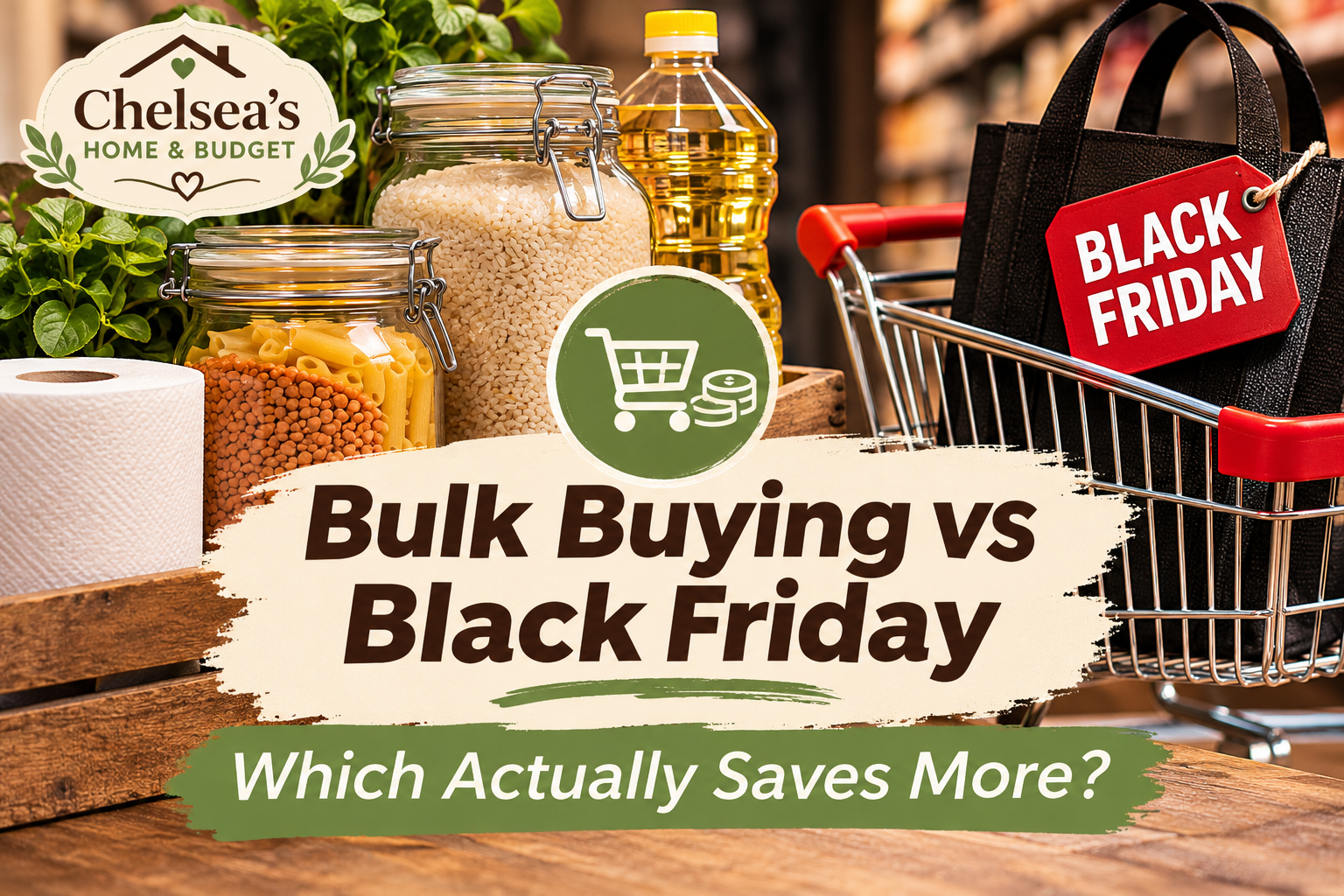
Black Friday is often advertised as the perfect time to stock up on household essentials. But is a supermarket’s big November special really cheaper than buying in bulk?
Sometimes it is. Sometimes a wholesaler’s everyday price is better.
And sometimes buying a bigger pack means spending more money without getting better value.
For South African households trying to stretch their grocery budgets, knowing the difference can make a meaningful impact.
At Chelsea’s Home & Budget, we’re not choosing sides between supermarkets and bulk retailers. We’re comparing what each option actually costs and whether it makes sense for your household.
Quick Takeaway
Bulk buying isn’t automatically cheaper, and Black Friday doesn’t automatically offer the best price.
Before choosing between them, consider:
- The price per kilogram, litre or unit.
- Whether the products are genuinely comparable.
- How much money you need upfront.
- How long the products will last in your household.
- Storage, delivery and travelling costs.
- Whether you already have enough stock at home.
The best deal is the one that gives you the most useful value for your money — not necessarily the biggest pack.
1. Does a bigger pack actually cost less?
One of the easiest mistakes when buying in bulk is assuming that larger packaging means better value.
Let’s look at a simple example using rice.
| Pack size | Price | Price per kg |
|---|---|---|
| 2 kg | R58 | R29 |
| 5 kg | R130 | R26 |
| 10 kg | R270 | R27 |
Illustrative prices only — not current retailer offers.
Surprisingly, the 10 kg bag isn’t the cheapest option per kilogram.
Buying two 5 kg bags would cost R260 for the same total weight, compared with R270 for the single 10 kg bag.
That’s R10 less for the same quantity.
The difference might look small, but comparing unit prices across several household products can help prevent unnecessary spending.
This is why we should calculate the real cost before choosing a bulk pack.
2. How to calculate the price per unit
You don’t need complicated calculations.
Simply divide the selling price by the quantity.
Price per kilogram = Total price ÷ Weight in kilograms
For example:
R130 ÷ 5 kg = R26 per kilogram.
The same idea applies to liquids, multipacks and household products.
For toilet paper, compare the roll size and number of sheets rather than assuming every roll offers the same quantity.
For washing powder, consider the amount required per wash, especially when comparing concentrated and ordinary detergents.
Chelsea’s Budget Tip: Keep a small record of prices for the household essentials you regularly buy. You don’t need to track everything — even knowing the usual price of rice, cooking oil, washing powder and toilet paper can make comparisons much easier.
3. When buying in bulk makes sense
Bulk buying can be useful when you’re purchasing products your household regularly consumes.
Good candidates to investigate include:
- Rice, maize meal, pasta and dried legumes.
- Cooking oil and selected long-life groceries.
- Washing powder and dishwashing products.
- Toilet paper and toiletries.
- Pet food and other frequently used supplies.
The advantage isn’t always limited to a lower price.
Having extra stock available could mean fewer shopping trips and less pressure to purchase an essential at a higher price later.
But that only works if you can afford the quantity and store it properly.
Buying three months’ worth of something when you only have enough money for this month’s necessities isn’t necessarily a good decision, even if the unit price is excellent.
4. When Black Friday specials are the better option
Sometimes a supermarket’s limited-time promotion beats a bulk retailer’s ordinary price.
For example, a smaller pack may be heavily discounted while the larger pack remains at its normal selling price.
This is especially worth checking when retailers run loyalty-card promotions, multibuys or temporary reductions on everyday essentials.
But be careful with the conditions.
A deal that requires you to buy four items isn’t necessarily worthwhile when you only need one.
Similarly, a special that applies exclusively to selected stores might not justify an additional shopping trip.
Compare the total quantity you need, rather than simply choosing the product with the largest advertised discount.
5. Don’t forget what it costs to reach the store
Imagine finding a bulk offer that saves you R20 compared with a nearby supermarket.
That sounds useful.
But what if collecting it requires an additional R35 in fuel?
Your R20 product saving has effectively become R15 in extra spending.
This is an illustrative calculation, not a current store comparison.
It doesn’t mean distant shops are always a poor choice. You might save substantially more by purchasing several items together.
The point is to compare the overall shopping trip.
Before driving to a wholesaler or visiting several supermarkets, ask whether you can combine purchases and whether the total saving is worth the journey.
6. Storage and waste can cancel out a saving
Bulk buying works best when the products can be stored safely and used before they deteriorate.
Dry groceries need suitable storage to protect them from moisture and pests.
Cleaning products should remain properly sealed and stored according to their labels.
Fresh produce requires more careful planning.
A large bag of potatoes might look like exceptional value per kilogram, but if a substantial portion spoils before your household can use it, the effective cost rises.
For smaller households, buying less more frequently may sometimes be the better choice.
A bargain only helps when you can actually use what you’ve bought.
7. What about meat hampers?
Meat hampers deserve a separate kind of comparison.
Two hampers might both contain 10 kg of meat but offer very different value.
One could contain mostly bone-in chicken, while another includes beef, pork, mince and other cuts.
We need to consider:
- Which cuts are included.
- Whether the advertised weight includes substantial bone.
- The price of purchasing comparable cuts separately.
- Whether your household will use everything.
- Freezer space and any delivery charges.
That’s why we’ll be examining selected bulk butchery specials and meat hampers in more detail throughout Black November.
8. Build a household stock-up plan
Before buying large quantities, divide your shopping needs into three groups.
1. Buy now
Essentials you’re running short of and genuinely need for the coming weeks.
2. Stock up when the value is convincing
Products you use regularly, have space to store and can purchase without compromising other necessities.
3. Leave for another month
Products you already have sufficient stock of or that aren’t offering meaningful savings.
One of the most useful benefits of bulk buying is having supplies left over for a more difficult month.
If you’ve already stocked up successfully, there’s no reason to keep buying more simply because another promotion appears.
Chelsea’s Budget Tip: Let your extra stock carry forward. A cupboard containing next month’s essentials can be just as valuable as finding another discounted product today.
Chelsea’s Value Check ✓
Here’s how we’ll assess bulk-buying opportunities throughout Black November.
✓ Worth it
The quantity offers a convincing cost advantage, suits your household and can be purchased without compromising other essentials.
~ Depends
The unit price is competitive, but the bulk quantity, upfront cost, travelling distance or storage requirements may not suit everyone.
× Skip
The larger pack costs more per comparable unit, encourages unnecessary spending or is likely to create waste.
Want the full grocery and bulk-price comparisons?
Throughout November, Chelsea’s Home & Budget will investigate selected supermarkets, wholesalers, cash-and-carry retailers and bulk suppliers.
Our free articles will highlight worthwhile findings and practical ways to compare offers.
For readers who want more detail, Chelsea’s Budget Club provides fuller store comparisons, calculated unit prices and selected household and meat-special reports as they become available.
The first month is free, followed by R50 per month until cancelled.
One final thought
Buying more doesn’t automatically mean saving more.
Sometimes the best deal is a large pack from a wholesaler.
Sometimes it’s a smaller supermarket special.
And sometimes it’s making use of what you already have instead of spending anything extra.
The best value comes from buying the right quantity, at the right price, for your household’s actual needs.
That’s what we want every Chelsea’s Home & Budget comparison to help you discover.
All numerical price examples in this article are illustrative and do not represent current retailer offers. Actual prices, product specifications, promotion conditions and availability should be confirmed directly with retailers before purchasing.
Leave a Reply