Buying the biggest pack on the shelf can feel like the obvious budget choice.
Sometimes it is.
But a larger pack only saves money when the unit price is actually lower, your household can use the quantity, and storing it does not create another problem.
Bulk buying is not automatically good budgeting. The goal is to buy more value, not simply more product.
Quick takeaway
A bulk pack is worth considering when the price per kilogram, litre or usable unit is genuinely lower and your household will use the product before it expires or deteriorates. If the quantity creates waste, ties up money you need elsewhere or costs more per unit, the bigger pack is not the better deal.
Start with the unit price
Start with the unit priceThe first thing to check is whether the larger pack is actually cheaper for the amount you receive.
A bigger packet can look like better value simply because it contains more product, but that does not guarantee a lower unit price.
Compare the price per kilogram, litre, 100 g, roll, tablet or other useful unit.
For example, if two packs contain different quantities, comparing the shelf price alone tells you very little. The smaller pack may cost less overall while the larger pack may cost less per kilogram — or the supermarket promotion may make the smaller packs the better buy.
The word bulk is not a value calculation.
The unit price is.
Make sure the quantity is useful
Make sure the quantity is usefulEven an excellent unit price can become poor value if your household cannot use the product.
Long-life staples, cleaning products, toilet paper and other items you regularly replace can be good candidates for bulk buying because they are unlikely to spoil quickly.
Fresh produce, short-dated food and products your household uses slowly need more caution.
Ask whether you have enough storage, whether the product will remain usable, and whether buying that quantity will actually reduce future spending.
There is also a difference between buying extra because the price is unusually good and buying extra because a large pack happens to be sitting in front of you.
A bargain that eventually ends up in the bin was never really a saving.
Do not let a bulk buy swallow the rest of the budget
Do not let a bulk buy swallow the rest of the budgetBulk buying can reduce future costs, but it requires more money upfront.
That matters when the household budget still needs to cover fresh food, transport, electricity, toiletries, pet supplies or other essentials.
Spending a large portion of the month’s available money on one excellent deal can still leave the rest of the budget under pressure.
The best bulk purchases are usually products you already use consistently and would have needed to replace anyway.
It can also help to think about how long the purchase should last. If a large pack replaces several future purchases, part of its value is that you will not need to buy the item again next week or next month.
That is very different from buying a large quantity of something simply because it is discounted.
Chelsea’s Value Check ✓
✓ Worth it — Genuine value for the price, quantity and intended use.
~ Depends — Can be worthwhile, but it depends on the household, quantity, quality or alternative options.
× Skip — The advertised deal does not offer strong enough value compared with the alternatives.
VALUE CHECK NOTE — For bulk buys, I look at the unit price, normal price, useful quantity, storage, waste risk and whether the purchase makes sense within the rest of the household budget. Bigger is only better when the extra quantity is genuinely useful.
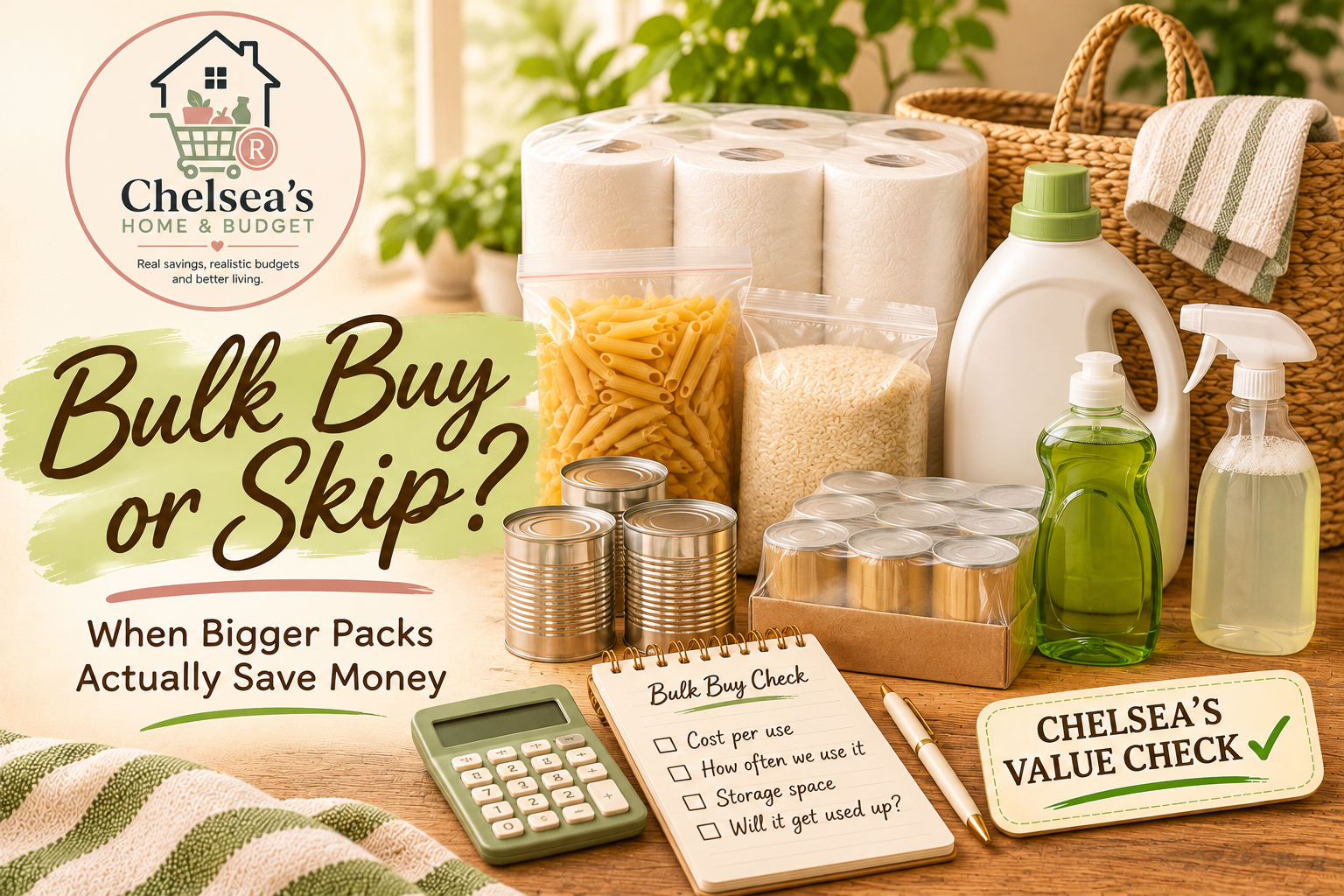
Quick checklist
- Is the unit price actually lower than the smaller pack?
- Is this something my household already uses regularly?
- Can I store the full quantity safely and practically?
- Will we use it before it expires, deteriorates or gets forgotten?
- Does buying it now still leave enough money for the rest of the household’s needs?
- Is there a smaller pack or alternative that gives similar value without tying up as much money?
Keep reading
Bulk buying works best when it reduces future spending without creating waste or putting the rest of the month under pressure. Browse more Budget & Home guides for practical ways to compare prices, quantities and everyday household value.