
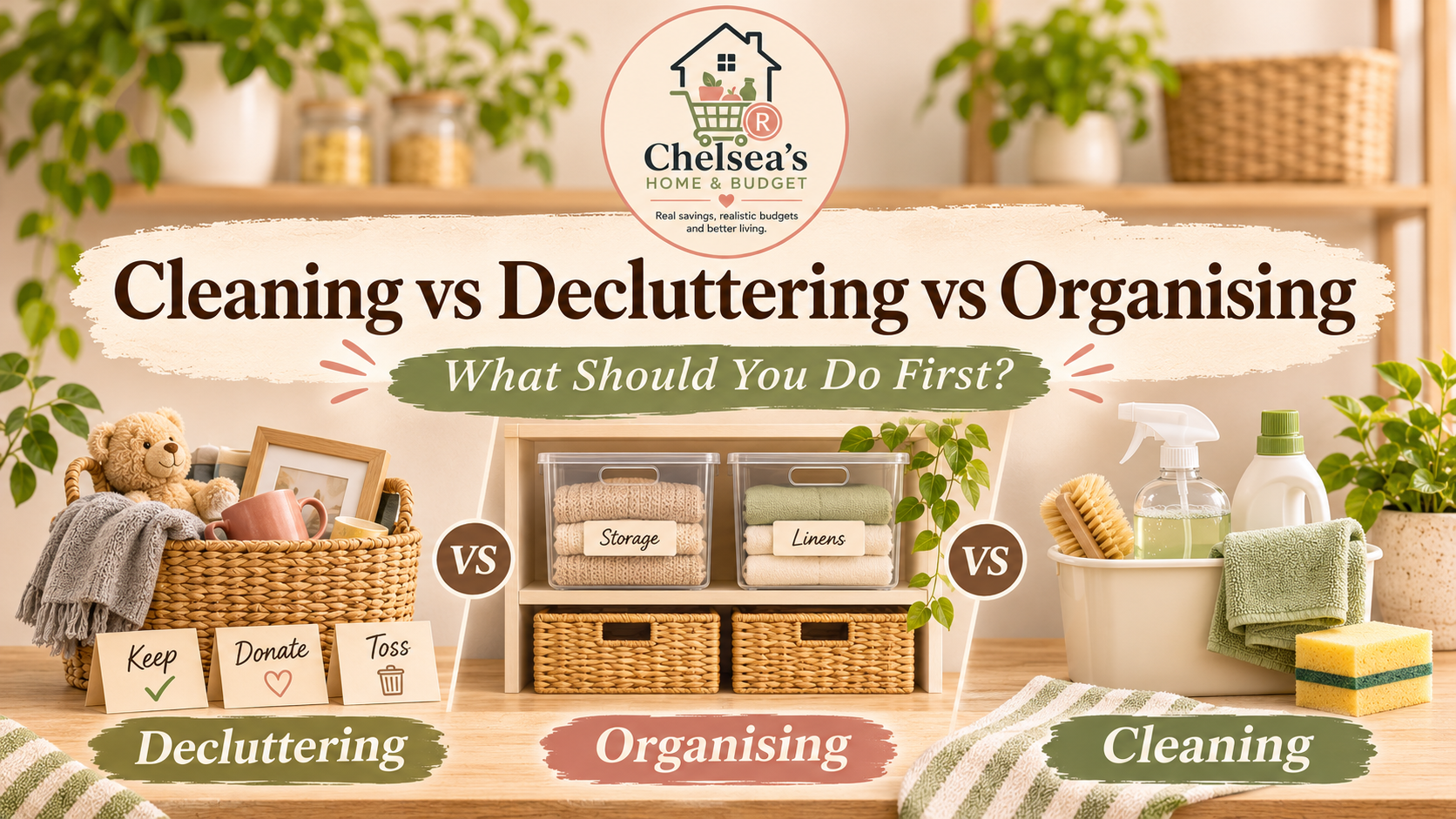
Cleaning, decluttering and organising are often treated like the same job, but they solve different problems.
That matters because choosing the wrong one can turn a simple reset into hours of frustration.
If the room is dirty, organising will not fix it. If the room is overcrowded, cleaning around everything will only get you so far. And if everything is clean but nothing has a practical home, decluttering alone will not solve the daily mess.
The first step is figuring out which problem you actually have.
Quick takeaway
Cleaning removes dirt. Decluttering reduces what you own. Organising decides where the things you keep should live. Start with the problem that is making the space hardest to use, instead of trying to do all three at once.
Cleaning: when the problem is dirt
Cleaning: when the problem is dirtCleaning is about hygiene and visible dirt.
That includes washing dishes, wiping counters, cleaning bathrooms, vacuuming or sweeping floors, washing bedding, removing rubbish, and dealing with spills, dust or grease.
If a room is cluttered but the main problem is that it feels dirty or unhygienic, start with cleaning.
You do not need to reorganise cupboards or make decisions about every object first.
A useful cleaning reset can be as simple as clearing the obvious rubbish, collecting dishes, wiping one usable surface and cleaning the main floor path.
The goal is to make the space cleaner and easier to use.
Decluttering: when there is simply too much
Decluttering: when there is simply too muchDecluttering is about deciding what stays and what goes.
The problem here is not necessarily dirt. It is volume.
If cupboards are overflowing, drawers will not close, surfaces cannot stay clear, or you keep moving the same unused things from one place to another, the space may need decluttering more than organising.
Decluttering usually means deciding whether an item should be kept, donated, sold, recycled, discarded or moved somewhere more appropriate.
This is the stage where it helps to separate two different questions: “Do I need to keep this?” and “Where should this live?”
Organising too early can create very neat storage for things you do not actually need.
Organising: when the things you keep need a better home
Organising comes after you know what you are keeping.
Its job is to make everyday items easier to find, use and put away.
Good organising is not about making a cupboard look perfect for a photograph. It is about creating a system that works on an ordinary day.
That can mean keeping frequently used items within easy reach, grouping similar things together, using baskets for loose categories, keeping cleaning products near the room where they are used, giving each shelf or drawer a clear purpose, and storing rarely used items further away.
A good organising system should reduce effort.
If putting something away requires several unnecessary steps, the system is probably too complicated for daily life.
Quick checklist
- Is the main problem dirt or hygiene? Clean first.
- Is the main problem too much stuff? Declutter first.
- Is the space clean enough and the amount manageable, but items still have no practical home? Organise.
- Are all three problems happening at once? Start with rubbish, dishes and hygiene, then reduce obvious excess, then organise what remains.
- Avoid trying to clean, declutter and organise every object at the same time
Keep reading
A home does not need to be perfectly organised to work well.
The goal is to make everyday tasks easier and reduce the number of things you have to move, search for or think about.
Browse more Cleaning & Organisation guides for practical ways to make your space easier to manage.