A bright sale sticker can make something feel like a bargain before you have even looked at the numbers properly. Sometimes it is. Sometimes the larger pack costs more per kilogram, the “saving” is tiny, or you end up buying more than your household will actually use.
That is why I do not judge a deal by the sale sticker alone.
Quick takeaway
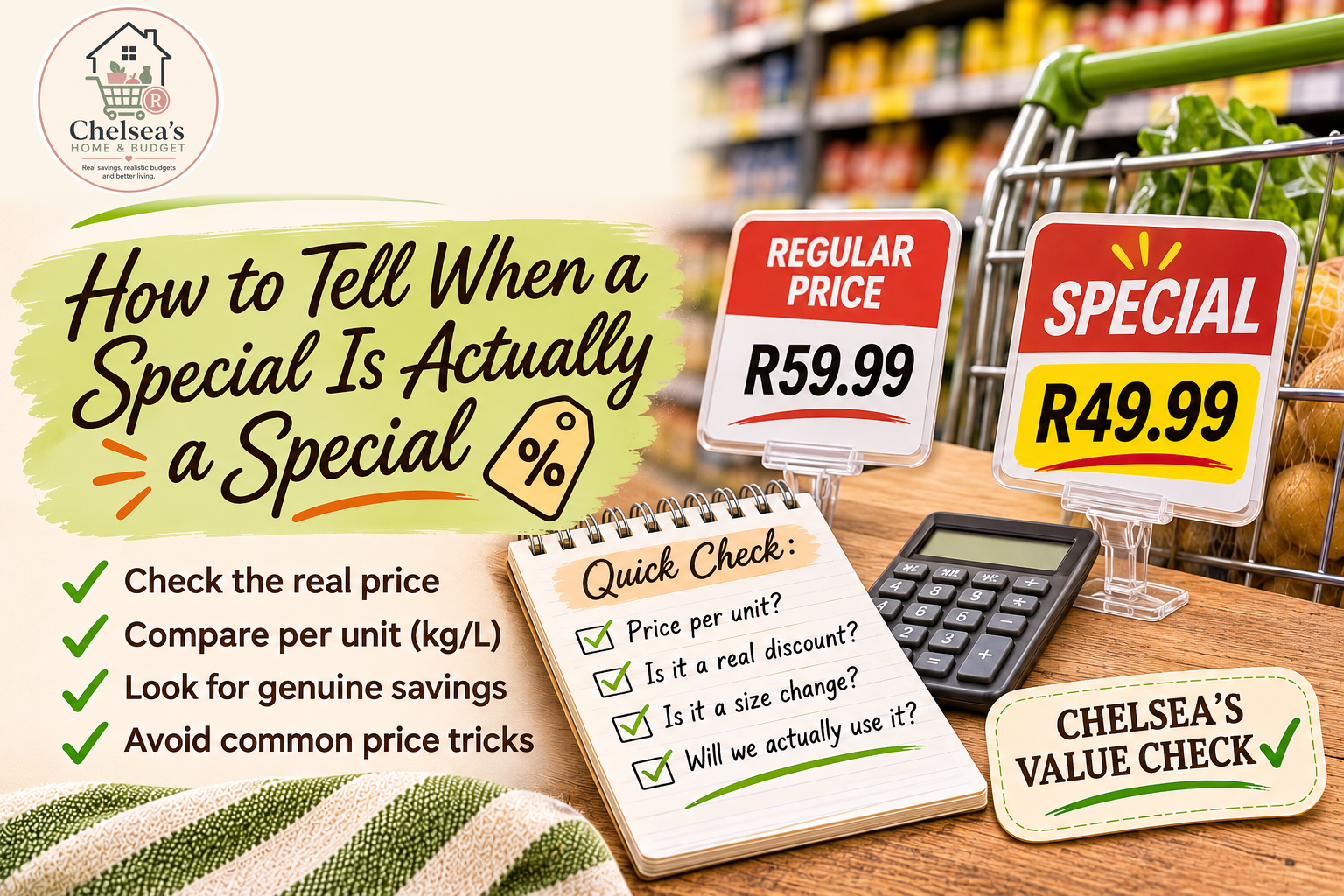
A genuine bargain should make sense beyond the advertised discount. Check the normal price, the unit price, whether the quantity is useful for your household, whether the quality is good enough, and whether there is a better alternative before calling something a deal.
Start with the real price, not the sale sticker
Start with the real price, not the sale stickerA discount only means something if you have some idea of what the item normally costs.
If something appears on promotion every few weeks at roughly the same price, the latest “special” may simply be its usual promotional price rather than an unusually good deal.
The next step is to compare the unit price. Look at the cost per kilogram, litre, 100 g, roll, tablet or other useful unit instead of comparing pack prices alone.
A R100 pack can be better value than a R70 pack — but the opposite can also happen. A large “family pack” is not automatically cheaper per kilogram just because the total price is higher.
Learning the usual prices of the products your household buys repeatedly makes this much easier over time.
Good value only counts if your household can use it
Good value only counts if your household can use itBulk buying can save money, but only when the quantity is practical.
A very low unit price is not much help if half the food expires, the product goes stale, or an oversized pack sits unused for months. The same applies to fresh produce: a cheap tray is not good value if a large portion ends up in the bin.
Quality matters too.
The cheapest product is not always the least expensive option over time. If you need twice as much of it, it breaks quickly, performs poorly or nobody in the household wants to use it, a slightly more expensive option may offer better value.
On the other hand, some everyday products are very similar and the extra cost is mostly the brand name. That is why value should be judged by what you actually get for the money, not by price alone.
Always check the alternative
Always check the alternativeBefore calling something a bargain, look at what else the same money could buy.
The alternative might be another brand, another pack size, another retailer, buying only the amount you need, or simply waiting for a better promotion.
A product can technically be discounted and still be more expensive than a perfectly suitable alternative elsewhere.
This becomes especially important during large promotional periods such as Black Friday, when the advertised saving can look impressive without necessarily representing unusually good value.
The useful question is not simply “Is this on special?”
It is “Is this the best practical value for what I actually need?”
Chelsea’s Value Check ✓
✓ Worth it — Genuine value for the price, quantity and intended use.
~ Depends — Can be worthwhile, but it depends on the household, quantity, quality or alternative options.
× Skip — The advertised deal does not offer strong enough value compared with the alternatives.
VALUE CHECK NOTE — When I review specials, store comparisons and everyday products on Chelsea’s Home & Budget, I use these checks before assigning a rating. A large advertised discount alone is never enough to earn a ✓ Worth it.
Quick checklist
- Is this genuinely cheaper than its normal price?
- Is the price per kilogram, litre or usable unit good?
- Will my household realistically use the quantity?
- Is the quality suitable for what I need it to do?
- Is there an equally useful alternative for less?
Keep reading
The same Value Check is used throughout Chelsea’s Home & Budget when comparing specials, household products, store prices and everyday buys. Browse more Budget & Home guides to make the numbers behind the promotion easier to judge.